
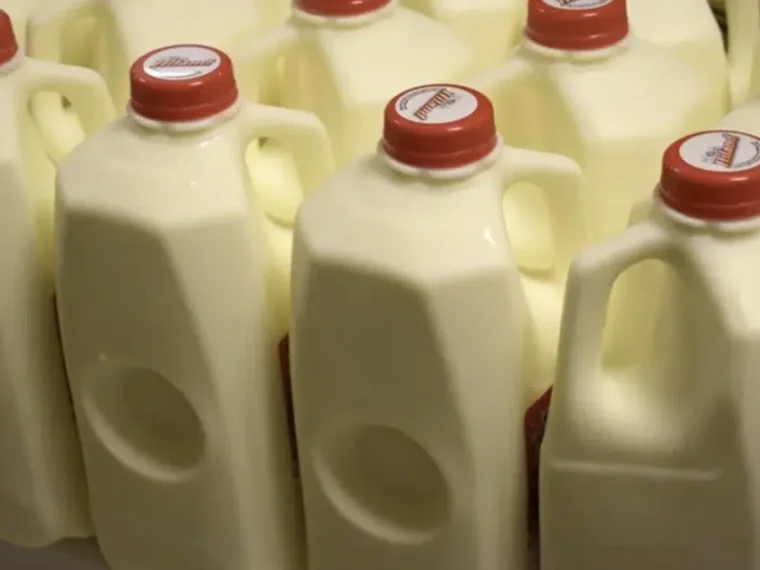
Have you ever noticed the strange circular dent on the side of a plastic milk jug and wondered why it is there? It might look like a random feature in the design, but that little indentation actually serves an important purpose.
The circular dent is designed to help the jug handle pressure and changes in volume without easily cracking or bursting.
Why Do Milk Jugs Have That Dent?
Plastic milk jugs are usually made from flexible high-density polyethylene (HDPE). Unlike rigid bottles, these thin containers can slightly change shape as the pressure inside or outside the jug changes.
The circular indentation gives the plastic a kind of flexible area. Instead of forcing the entire container to withstand pressure changes, the dent can move inward or outward slightly.
This is particularly useful when milk is transported, stored, refrigerated, and eventually brought home.
It Helps the Jug Flex
Think of the dent as a small built-in flexibility point.
If the pressure inside the jug changes, the plastic can deform around the indentation instead of becoming stressed in one rigid area. This helps reduce the likelihood of the container cracking or splitting.
The same principle is used in many types of packaging. Engineers often add curves, grooves, and indentations to containers because curved or flexible surfaces can handle forces differently from completely flat ones.
Temperature Changes Matter Too
Milk jugs can experience several temperature changes before they reach your refrigerator.
They may be filled at a processing facility, stored in refrigerated areas, transported in refrigerated trucks, displayed in a supermarket cooler, and then carried home.
As temperature and pressure conditions change, the plastic can expand, contract, or flex slightly.
The indentation provides the container with some room to accommodate these changes.
Is It There to Show Whether the Milk Is Spoiled?
No. That’s a common misconception.
You may have heard that the dent somehow indicates whether milk is fresh or spoiled. The dent itself isn’t a reliable freshness indicator.
If a milk jug becomes unusually swollen, collapsed, leaking, or otherwise deformed, however, that can be a reason to inspect the container and check the milk’s condition rather than relying on the indentation alone.
Always check the expiration or use-by information and follow proper refrigeration and food-safety practices.
Why Doesn’t Every Milk Container Have One?
Packaging varies depending on the manufacturer, container material, shape, and production method.
Some milk is sold in rigid plastic bottles, cartons, or other containers that use completely different structural designs. Those containers may not need the same type of indentation.
The design of a milk jug is ultimately a balance between durability, flexibility, manufacturing efficiency, storage, and transportation.
There’s More Engineering Behind a Milk Jug Than You Might Think
That little circular indentation is a good example of how everyday packaging can contain surprisingly thoughtful engineering.
What looks like a simple plastic jug has to survive filling equipment, transportation, refrigeration, handling by shoppers, and storage in your refrigerator—all while using relatively little plastic.
So the next time you grab a gallon of milk, take a look at that little circular dent.
It isn’t just decoration.
It’s a small part of the jug’s design that helps the container flex, absorb changes, and stay intact throughout its journey from the dairy to your refrigerator.