
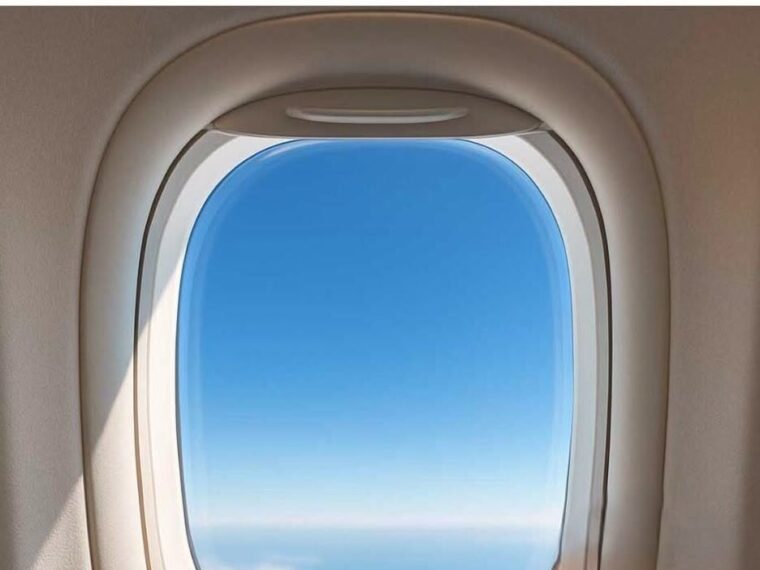
Have you ever looked out of an airplane window and noticed something that seems almost universal? Whether you’re flying on a tiny regional aircraft or a massive long-haul jet, the windows are almost always rounded or oval-shaped.
At first glance, it might seem like an aesthetic choice. Rounded windows look sleek, modern, and perhaps a little more elegant than square ones.
But there’s a much more important reason.
The shape of an airplane window is a matter of safety.
The story goes back to the early days of commercial jet aviation, when engineers discovered that a seemingly harmless design choice could have devastating consequences at high altitude.
✈️ Why Can’t Airplane Windows Be Square?
To understand the problem, you have to think about what happens to an airplane thousands of feet above the ground.
Inside a pressurized aircraft, the air pressure is higher than the extremely thin air outside. The cabin is essentially a pressurized environment surrounded by a fuselage that has to contain that pressure throughout the flight.
Every time an aircraft climbs, the pressure difference between the inside and outside creates stress in the fuselage.
That stress needs to be distributed as evenly as possible.
And that’s where the shape of the windows becomes incredibly important.
A square or rectangular opening has sharp corners, and sharp corners can concentrate stress.
Instead of spreading the force smoothly around the opening, stress tends to accumulate around those corners.
A rounded window, on the other hand, allows the pressure forces to flow much more evenly around the opening.
It sounds like a tiny engineering detail.
It isn’t.
💥 The Tragic Lesson From Early Jet Aircraft
The importance of rounded windows became painfully clear in the 1950s with the de Havilland Comet, one of the world’s first commercial jet airliners.
The Comet was revolutionary. It was faster, quieter, and capable of flying at higher altitudes than many of the piston-powered aircraft of the time.
But several Comets suffered catastrophic structural failures in flight.
Investigations eventually revealed that metal fatigue around the aircraft’s square-ish window and other openings played a crucial role.
Repeated pressurization and depressurization cycles caused tiny cracks to develop in the aircraft’s structure.
Those cracks could grow over time until the surrounding structure could no longer withstand the stresses involved.
The consequences were catastrophic.
These accidents forced the aviation industry to take a much closer look at how pressurized aircraft structures were designed.
🔬 The Problem Wasn’t Simply “Square Windows”
It’s worth correcting one popular version of the story.
It isn’t quite accurate to say that square airplane windows simply “cracked planes in half.”
The real engineering problem involved stress concentrations, fatigue, structural design, and repeated pressurization cycles.
The corners of windows and other openings could become particularly vulnerable areas where stress accumulated.
Once a small crack formed, repeated cycles could allow it to grow.
The Comet disasters became an important lesson in aircraft structural engineering and helped lead to major changes in how future aircraft were designed and tested.
🪟 Why Rounded Windows Work Better
continue reading in page 2