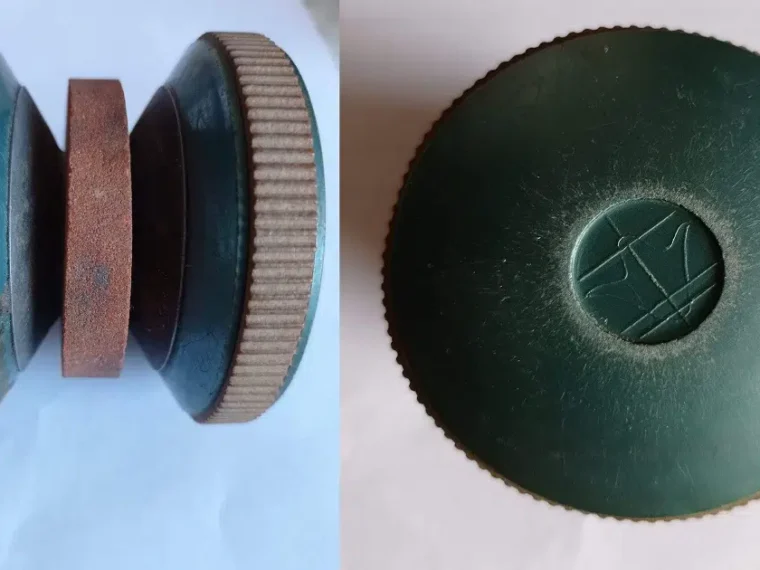
It’s amusing how something that is common can be an absolute mystery after enough time has passed. You’re rummaging through your grandmother’s kitchen drawer, or you’re scrolling through a Facebook group with people salvaging their deceased uncle’s basement, when all of a sudden someone posts a photo like, “What the hell is this?” It seems a little menacing. Metal parts, an apparent handle, and a strange rough wheel in the middle. It could be a torture device. It may be a tool. Eventually, someone finally responds—oh yeah, an old knife sharpener.
Which, when you see it, makes absolute sense. Sort of.
Anyway, this happened in one of those vintage kitchen groups. Someone posts this old broken contraption with zero context, and everyone is guessing stuff. Eventually, someone finally identifies it for what it is: an antique-style knife sharpener. Not the new electric things. Not the new ceramic handheld ones shaped like a boomerang. This clearly has a handle, a grinding stone in the center, and a definite “I’ve been here longer than you have” vibe.
It seems knife sharpeners have been with us for centuries. Wild, right? Like, it’s true—blades get dull. They always have. You can’t slice meat or dice an onion or shave herbs with a dull piece of steel. So, sharpeners have always been in a cook’s toolkit in one form or another. They just didn’t start off as slick electric gadgets with all sorts of settings and guides and motorized polishers. They were basic. Most commonly two pieces of metal or stone or ceramic wedged together with something gritty between them. And you’d just run your knife through, and through, over and over again, with the hope that you’d be able to revive the edge and not lose a finger.
Some of those old models even had a crank handle. Other ones had rough-hewn sharpening stones, where you’d grip the stone in one hand, and the knife in the other. Not good for the weak, but very effective if you knew what you were doing.
So, the one that popped up on Facebook? It looked like something you might find in the corner of a Depression-era farmhouse that someone found at an estate sale. And it quite likely was. And here’s the thing—even if it seemed ancient and maybe quirky to describe, it still had a utilitarian purpose, because its principle isn’t too much different from what you can get today.
That little thing in the middle? That gritty wheel? That is the grinding stone. The same premise as in whetstones and honing tools, and even though the shape is different and the materials are high-fashion, the utilitarian purpose is the same—realign blade, clean out the nicks, sharpen the edge; make the knife usable again.
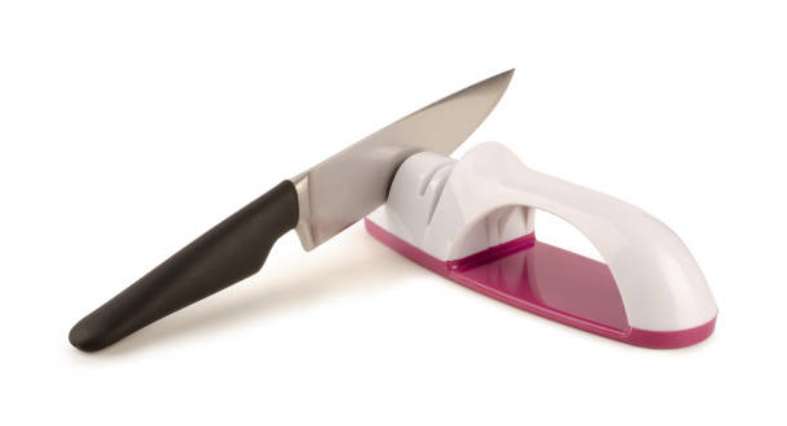
If I may be quite frank: if you cook a bit at home, a knife sharpener should be considered non-negotiable! It doesn’t matter if you are making full-course dinners or just slicing an apple for a lunchbox. A dull knife, at best, is an annoyance; at worst, it makes you dangerous. It slips. It crushes rather than slices, It turns cooking into work.
continue reading in page 2