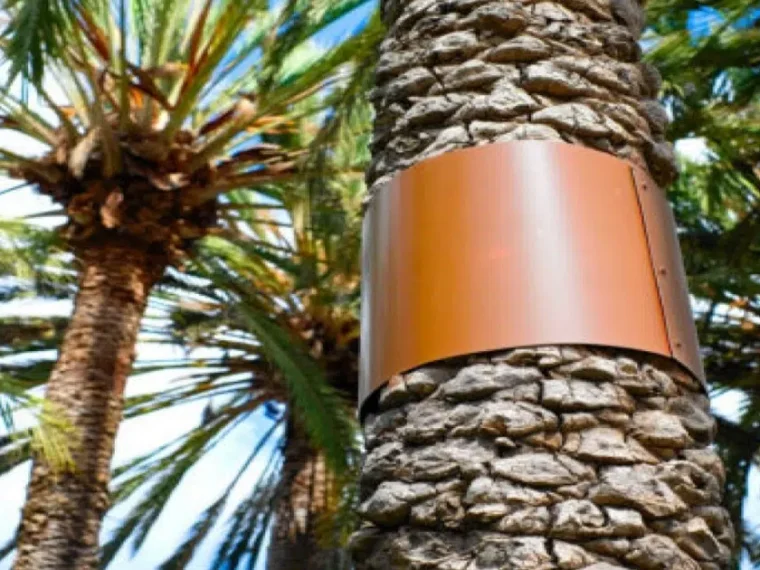
You ever be out walking—just vibing, not in a hurry, maybe half-listening to that Office Ladies podcast because you promised yourself no murder shows before noon—and then your eyes catch on something… off? Like, there’s this one sad-looking tree in the median strip with what looks like a sheet of metal wrapped around its trunk. Totally normal otherwise, but that shiny collar? Kind of unsettling.
And I’m standing there thinking, “Dang, did this tree have surgery or something?” Like maybe a squirrel hit it too hard or it threw its back out and now it’s in recovery. My brain goes straight to tree neck brace. Which, I realize, is not… technically a thing.
But turns out I wasn’t completely off. That metal? It’s not holding anything together. It’s not rehab equipment. It’s more like armor. A slick, quiet little force field—less for healing, more for keeping the wrong kind of visitors off its back.
I only learned this after asking someone at the park, mid-dog walk, what was going on. They gave me a look like I’d just asked if the sky was always blue, then explained: they’re called tree baffles. And now that I know what they are, I see them everywhere.
Not a Tree Cast—More Like Tree Armor
I thought these metal wraps were some kind of tree repair kit. I asked my husband and he also thought it was like that. You know, like patching up bark that had split. But really, they’re more like… pest armor. They’re there to stop squirrels, raccoons, rats—basically anything small and sneaky that sees a tall tree and thinks, “Nice, rent-free penthouse.”
I love squirrels as much as the next person (unless the next person’s had them living in their attic, which I have—zero stars, do not recommend). They’re cute. But also tiny acrobatic chaos agents. And they can seriously mess with a tree. Strip bark, build nests, launch rooftop invasions… all of it.

Enter the Baffles: Sleek, Slippery, and Strangely Satisfying
So here’s how tree baffles work: it’s basically a strip or cone of metal wrapped around the trunk, smooth side out. No fancy tech. Just physics. The surface is slick enough that critters can’t climb it. They try, they slide. It’s like watching someone try to climb an oiled waterslide. Not happening.
And because this is one of those simple-but-genius things, arborists—the folks who really know trees—are all for it. Doesn’t hurt the tree, keeps the pests off, and looks kinda cool once you know what it’s doing.
Bands vs. Cones (Yes, There Are Options)
So depending on your tree situation, there are two main baffle types.
Bands are wide strips of metal that wrap around the trunk like a belt. These are better for older, thicker trees—like the oaks that’ve been around since your street was dirt. You just fasten the band with wire, screws, or nails (carefully), and boom—squirrel deterrent. A little pro tip I didn’t think of: overlap the metal slightly, and mount it at least five feet up the trunk. Anything lower and the squirrels will laugh and leap right over it.
Also, you can paint them. Didn’t expect that. If you don’t want shiny metal catching sunlight, just blend it in. Go earthy, go subtle. Go full Bob Ross if you want.
Cones, on the other hand, are made for younger trees—like fruit trees or anything with thinner bark. They flare out like upside-down collars and do the same job: block climbers. You use the same hardware to install them, and they come in a bunch of sizes, so you don’t have to cut anything down to fit.

Why It Actually Works (A Satisfying Little Physics Lesson)
continue reading in page 2