
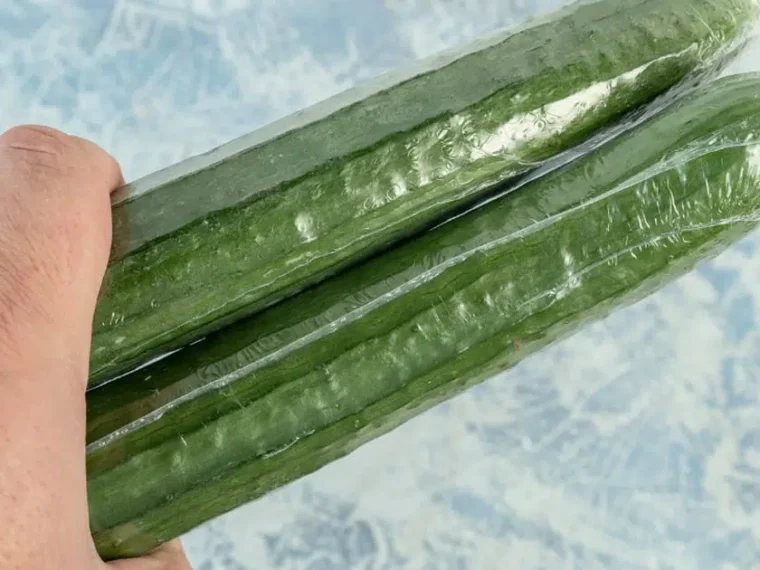
Have you ever walked through the produce section and noticed that English cucumbers almost always seem to be wrapped tightly in plastic?
At first glance, it seems a little strange. Cucumbers are already protected by a skin, so why put another layer around them?
The answer has a lot to do with moisture, shelf life, transportation, and food waste.
What Makes English Cucumbers Different?
English cucumbers, sometimes called seedless cucumbers, European cucumbers, or hothouse cucumbers, are different from many traditional garden cucumbers.
They’re typically longer and slimmer, with a thinner skin and fewer noticeable seeds. Their skin is also more delicate, which makes them pleasant to eat without peeling.
That thin skin, however, comes with a disadvantage.
English cucumbers can lose moisture relatively quickly.
And that’s where the plastic wrapping comes in.
The Plastic Helps Prevent Moisture Loss
A cucumber is mostly water. After it’s harvested, it continues to lose moisture to the surrounding environment.
If an English cucumber is left exposed to dry air for too long, it can gradually become:
- Soft
- Limp
- Wrinkled
- Shriveled
- Less crisp
Wrapping the cucumber creates a barrier that slows down water loss.
The plastic essentially helps keep moisture inside the cucumber instead of allowing it to evaporate into the air.
That means the cucumber can remain firm and crisp for longer while it’s being transported and displayed at the grocery store.
Why English Cucumbers Need More Protection
Traditional cucumbers often have a thicker, tougher skin that provides more natural protection.
English cucumbers are deliberately grown with a thinner skin because many people prefer their texture and flavor.
Unfortunately, that also makes them somewhat more vulnerable to moisture loss and physical damage.
The plastic wrapping provides an additional protective layer without requiring the cucumber itself to develop a thicker skin.
It Can Help Extend Shelf Life
For grocery stores, shelf life matters enormously.
A cucumber that stays attractive and firm for several extra days is much less likely to end up being thrown away.
That’s important because food waste doesn’t only mean losing the food itself. Resources used to grow, harvest, package, refrigerate, transport, and sell that food are also wasted when it gets discarded.
So while plastic packaging has obvious environmental disadvantages, the wrapping can also serve a practical purpose by helping reduce produce spoilage and food waste.
It’s one of those situations where packaging isn’t necessarily as pointless as it looks.
What About the Environmental Cost?
This is where things get complicated.
Plastic is a major environmental concern, and seeing a single cucumber individually wrapped can certainly feel excessive.
The plastic itself requires resources to manufacture and eventually becomes waste.
At the same time, food waste also has an environmental cost.
If removing the plastic causes a large percentage of cucumbers to spoil before they’re purchased, the environmental benefit isn’t necessarily as straightforward as simply saying “no plastic is always better.”
The ideal solution would be packaging that provides the necessary protection while using less material or a more sustainable alternative.
Does the Plastic Make the Cucumber Safer?
continue reading in page 2