
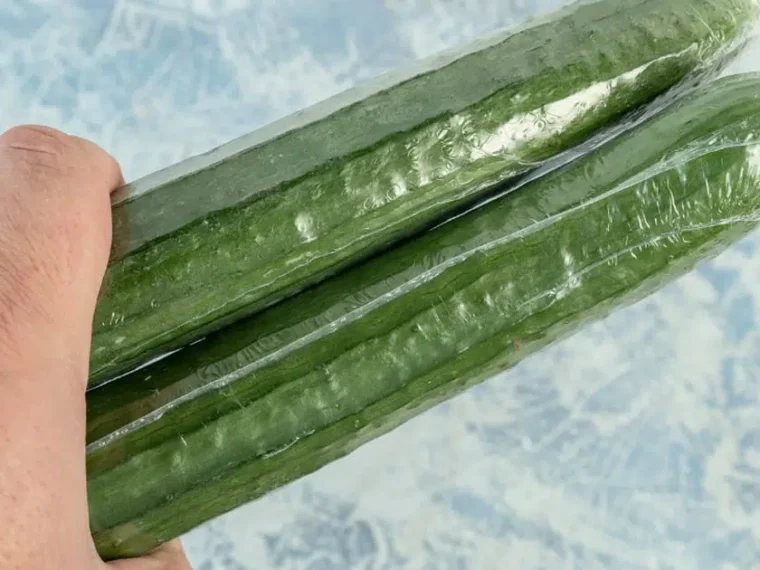
Not necessarily.
The main purpose of the wrapping isn’t to make the cucumber sterile or eliminate bacteria.
It’s primarily about preserving quality and reducing moisture loss.
You should still wash fresh produce appropriately before eating it, even if it comes wrapped in plastic.
And remember that washing the cucumber doesn’t mean you need to remove the skin. English cucumber skin is commonly eaten.
Why Not Just Use a Thicker Skin?
You might wonder why growers don’t simply produce English cucumbers with thicker skins so they wouldn’t require plastic.
Because the thin skin is part of what makes English cucumbers popular.
People often buy them specifically because they’re:
- Thin-skinned
- Crisp
- Mild tasting
- Easy to slice
- Convenient to eat without peeling
- Relatively low in large, noticeable seeds
Changing the cucumber itself could mean changing the characteristics consumers actually want.
The plastic wrapping is therefore partly a consequence of the way these cucumbers are grown and marketed.
Is the Wrapping Actually Vacuum-Sealed?
Despite the appearance, the plastic around many English cucumbers isn’t necessarily vacuum-sealed in the strict sense.
It’s more accurate to describe it as tight plastic wrapping or film packaging.
The goal is to create a barrier around the cucumber that significantly reduces moisture loss.
So if you’ve always called it “vacuum-wrapped,” you’re not alone—but the important part is the protective barrier, not necessarily a true vacuum inside the package.
How Should You Store an English Cucumber at Home?
Once you’ve brought one home, keeping it in the right conditions can help maintain its crisp texture.
If it’s still wrapped, you can generally leave it in its packaging until you’re ready to use it.
If you’ve opened or removed the plastic, keeping the cucumber protected from excessive moisture loss can help prevent it from becoming limp.
Avoid storing cucumbers right next to produce that releases large amounts of ethylene gas, because ethylene can accelerate deterioration of some fruits and vegetables.
And don’t leave a cucumber sitting around for weeks expecting it to remain as crisp as the day you bought it.
Fresh produce is still perishable, even when beautifully packaged.
So Is the Plastic Really Necessary?
For many English cucumbers, the plastic serves a genuine purpose.
It’s there primarily to slow moisture loss, preserve firmness, protect the delicate skin, extend shelf life, and reduce spoilage during transportation and retail storage.
That doesn’t mean plastic packaging is environmentally harmless. It simply means there’s more to the story than a grocery store randomly deciding to wrap every cucumber in plastic.
That little layer of film is essentially acting as an artificial protective skin.
And once you know what it’s doing, the packaging suddenly makes a lot more sense.
So the next time you see a perfectly long, crisp English cucumber sitting inside its shiny plastic sleeve, you’ll know that the strange-looking packaging isn’t just about appearance.
It’s helping keep all that water inside the cucumber—and keeping the cucumber crisp long enough to make it from the farm to your refrigerator.